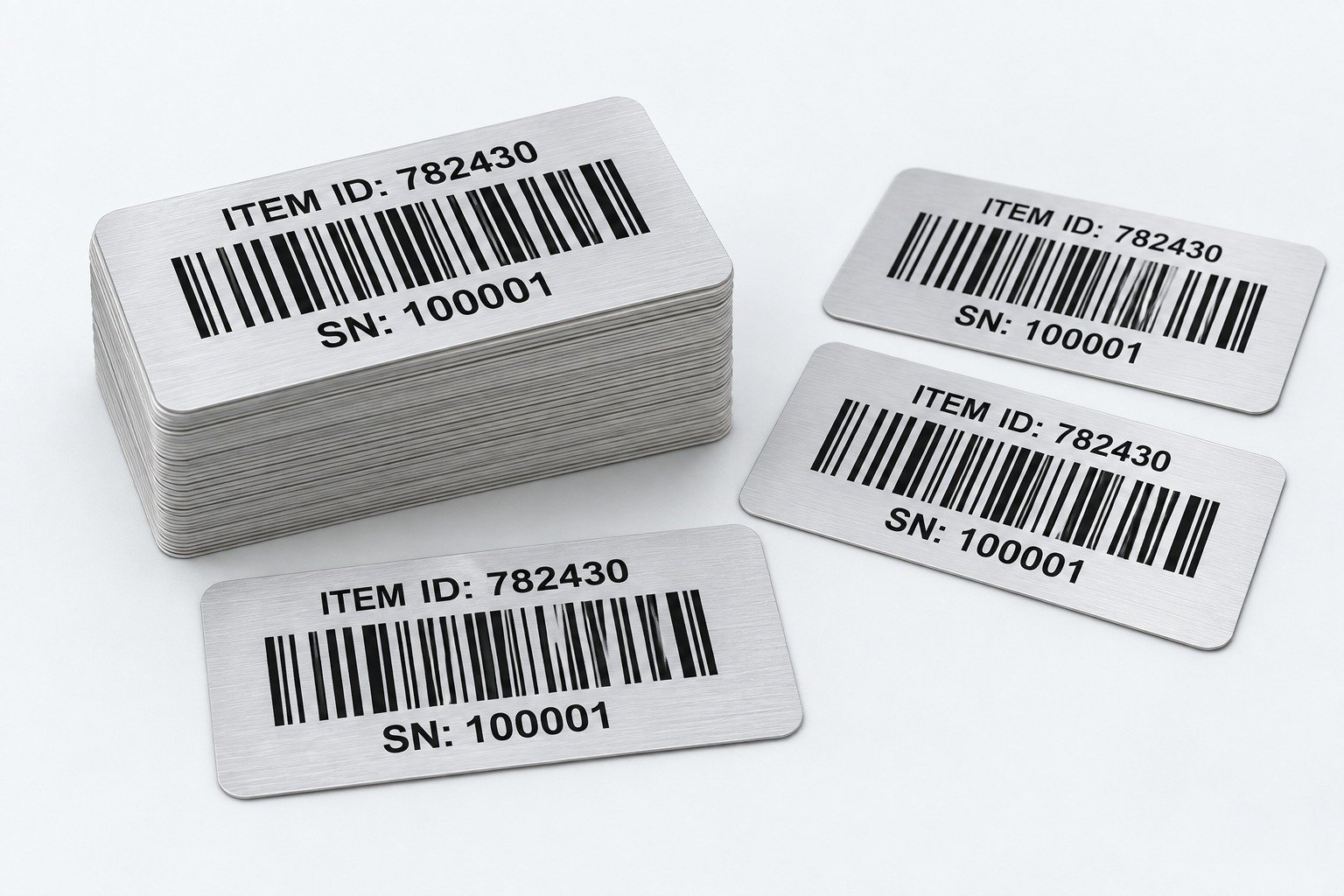
Frozen food labels may be pressure-sensitive labels, roll labels, carton labels, or other formats selected around the actual package, application method, information needs, and cold-chain exposure. There is no single construction suitable for every package.
StikTec food packaging label guide
Labels for Frozen Food Packaging
Labels for frozen food packaging should be selected by considering when the label is applied, how cold the package becomes, the packaging surface, and the risk of moisture, condensation, frost, abrasion, and temperature cycling. A label applied to a dry package before freezing may require a different construction from one applied in a cold room or directly to pre-frozen packaging.
For food brands, co-packers, and procurement teams, the right answer starts with the actual package and cold-chain process—not a generic claim that a label is “freezer grade.” Define the conditions first, then evaluate a proposed construction on the real product.
In this guide
- Application, service, and unused-label storage temperatures
- Frozen-food package surfaces, materials, and adhesive planning
- Condensation, frost, information layout, barcodes, testing, and ordering
Overview
Choosing Labels for Frozen Food Packaging
Direct answer: Frozen food packaging labels are printed labels used to identify, brand, track, and provide product information on packages stored or distributed at low temperatures. Their performance depends on the complete label construction and the actual cold-chain conditions.
Cold storage is only one part of the brief. The moment of application may be warm, chilled, cold, or frozen; the package may be dry, wet, smooth, textured, flexible, or rigid. Those details affect how an adhesive contacts the surface and how a label behaves after freezing.
Plan product information at the same time as the physical construction. Ingredient information, allergens, dates, languages, warnings, batch data, and barcodes must remain clear at the intended size. The buyer remains responsible for confirming all market-specific food, food-contact, and labeling requirements.
| Selection Area | Why It Matters |
|---|---|
| Application temperature | Adhesive directions can have different minimum application requirements. |
| Service temperature | The label must remain functional through the actual cold chain. |
| Packaging substrate | Plastic films, trays, cartons, and pouches behave differently. |
| Moisture exposure | Condensation, frost, and wet surfaces can reduce adhesion. |
| Product environment | Oil, abrasion, handling, and temperature cycling affect the finished label. |
| Required information | Product information, warnings, codes, and date details must remain readable. |
Temperature planning
Understand Application and Service Temperature
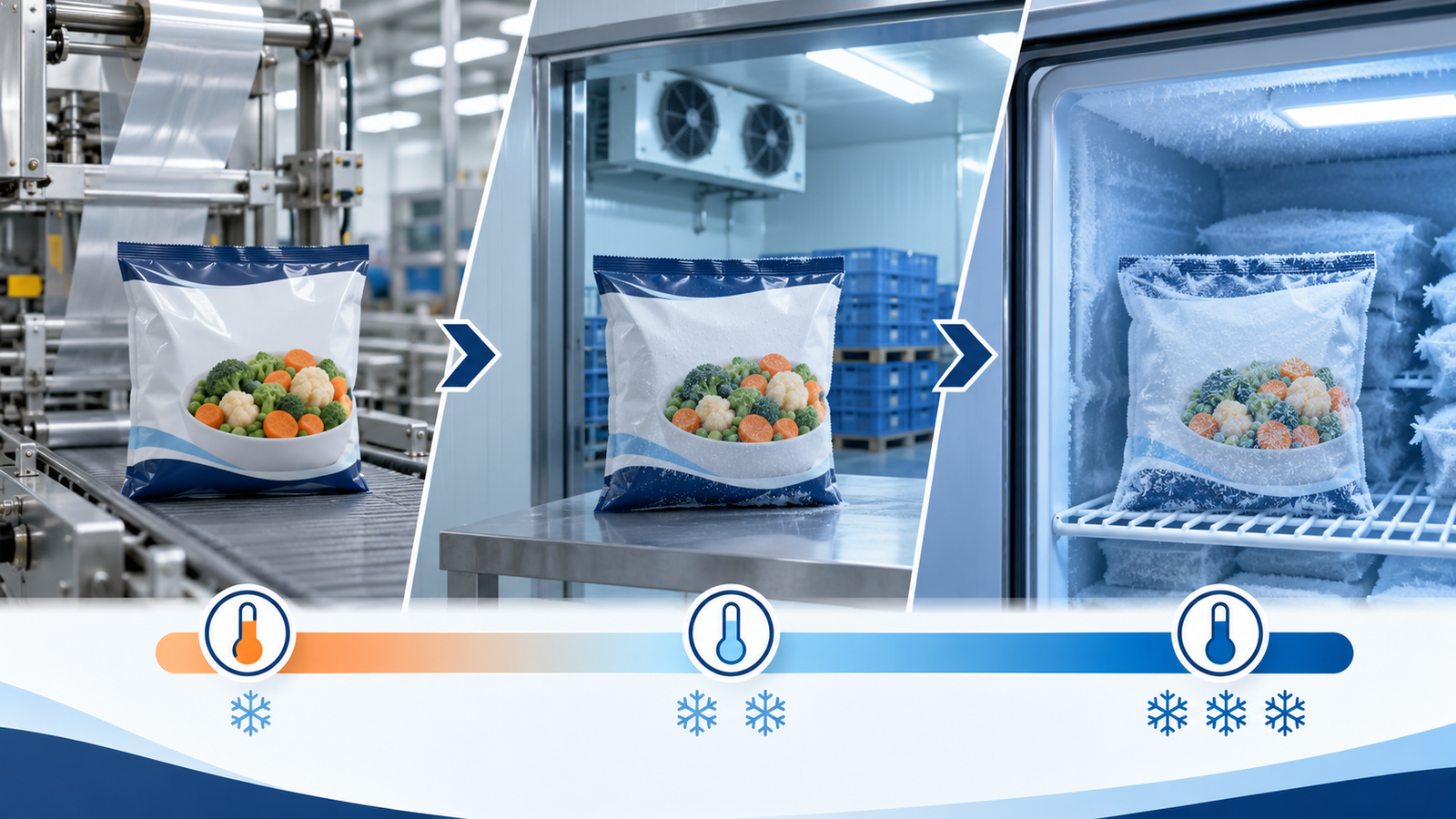
Application temperature is the temperature of the label, packaging, product, and labeling environment when the label is applied. Service temperature is the temperature range the applied label must withstand after it has bonded. Storage temperature describes how unused labels are kept before application.
These are separate questions. A label applied at room temperature to a dry package before freezing may need a different direction from a label applied in a chilled room. A label intended for freezer storage should not automatically be assumed suitable for application onto a pre-frozen or frosted package.
Temperature questions for buyers
- What is the temperature of the product and package at labeling?
- How long can the applied label bond before freezing?
- What is the lowest expected storage and transport temperature?
- Will the product move between freezer, refrigeration, ambient handling, and retail display?
| Temperature Term | Meaning | Buyer Question |
|---|---|---|
| Application temperature | Temperature of label, packaging, product, and area when applied | Is the package warm, chilled, cold, or already frozen? |
| Service temperature | Temperature range after the label has been applied | What occurs during freezing, warehousing, transport, and retail display? |
| Label storage temperature | Storage condition for unused rolls or sheets | Were labels stored according to supplier guidance before use? |
| Temperature cycling | Repeated movement between cold and warmer conditions | Will condensation occur during handling or distribution? |
Package surfaces
Match Labels to Frozen Food Package Materials
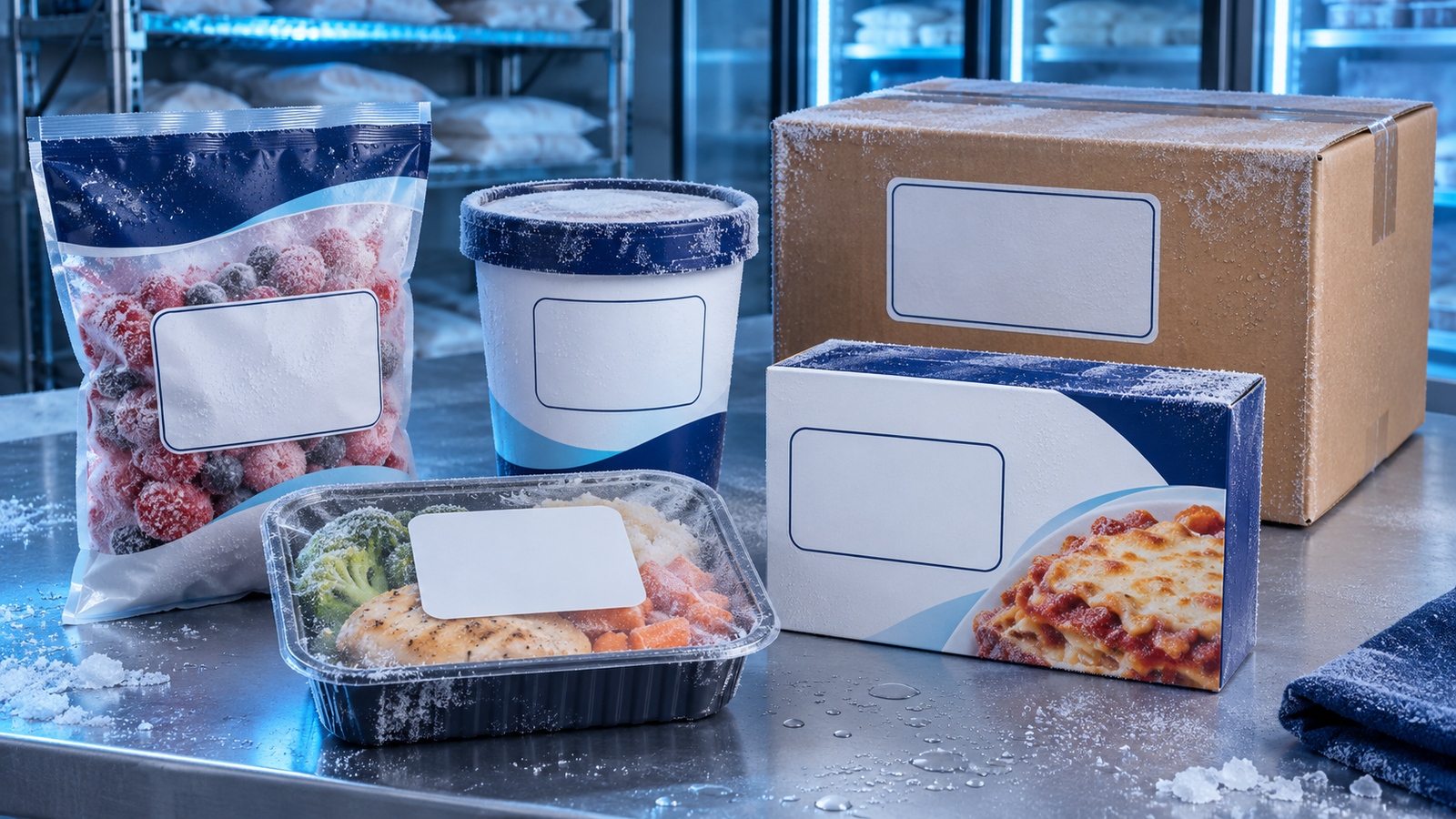
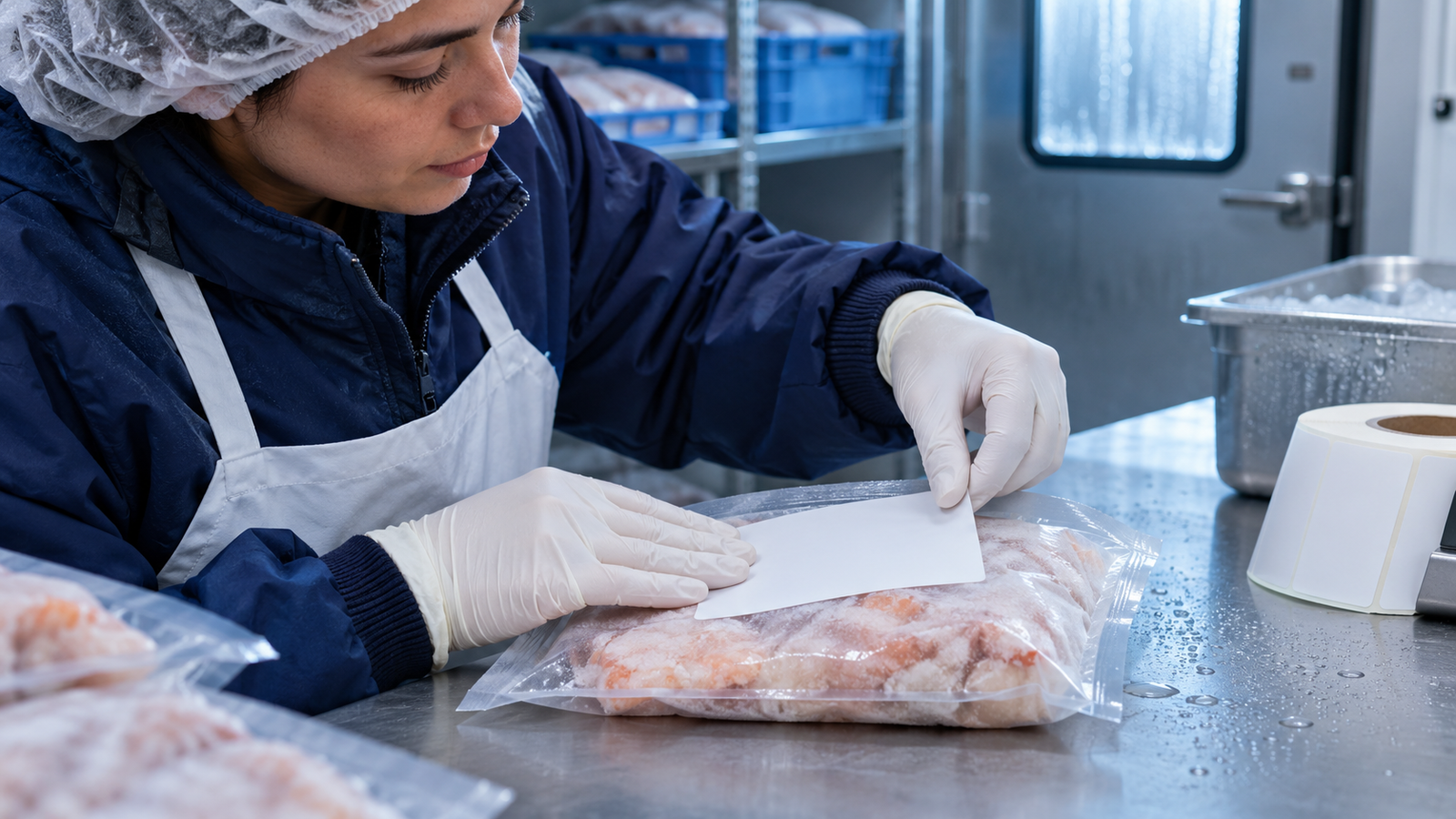
The package surface determines how the adhesive contacts the package. A flexible pouch can wrinkle as it is filled and frozen. A tray may have a different lid and body material. A carton may have a fibrous surface that changes with moisture. Review the actual package, filling process, and label position before selecting a construction.
For a new project, provide a representative empty and filled package where practical. Include information on seal zones, lid edges, curves, texture, print coverage, recycled content, coatings, and the expected route through packing and cold storage.
| Packaging Surface | Typical Frozen Food Use | Label Planning Considerations |
|---|---|---|
| Flexible plastic pouch | Vegetables, seafood, prepared meals, snack products | Film flexibility, wrinkles, seal zones, and moisture conditions |
| Plastic tray | Frozen meals, meat, desserts, prepared foods | Surface energy, lid material, moisture, and placement |
| Plastic tub | Ice cream, desserts, specialty foods | Curves, lid/body placement, cold storage, and handling |
| Paperboard carton | Frozen meals, vegetables, retail boxes | Fiber surface, carton moisture resistance, and cold exposure |
| Corrugated outer carton | Warehouse and shipping packs | Rough texture, cold storage, moisture, and barcode readability |
Material direction
Choose Label Materials for Cold Storage
Facestock selection should consider moisture, flexibility, print requirements, durability, and the package surface. Paper, PP film, PET film, PE film, clear film, white film, matte, glossy, and laminated directions each need to be assessed as a complete construction with the adhesive and real package conditions.
Do not select material from appearance alone. A glossy surface can change glare; a clear construction can change text contrast; a flexible material can behave differently on a curved pouch. Final material selection should be confirmed for the actual frozen-food package, labeling temperature, storage condition, and required service environment.
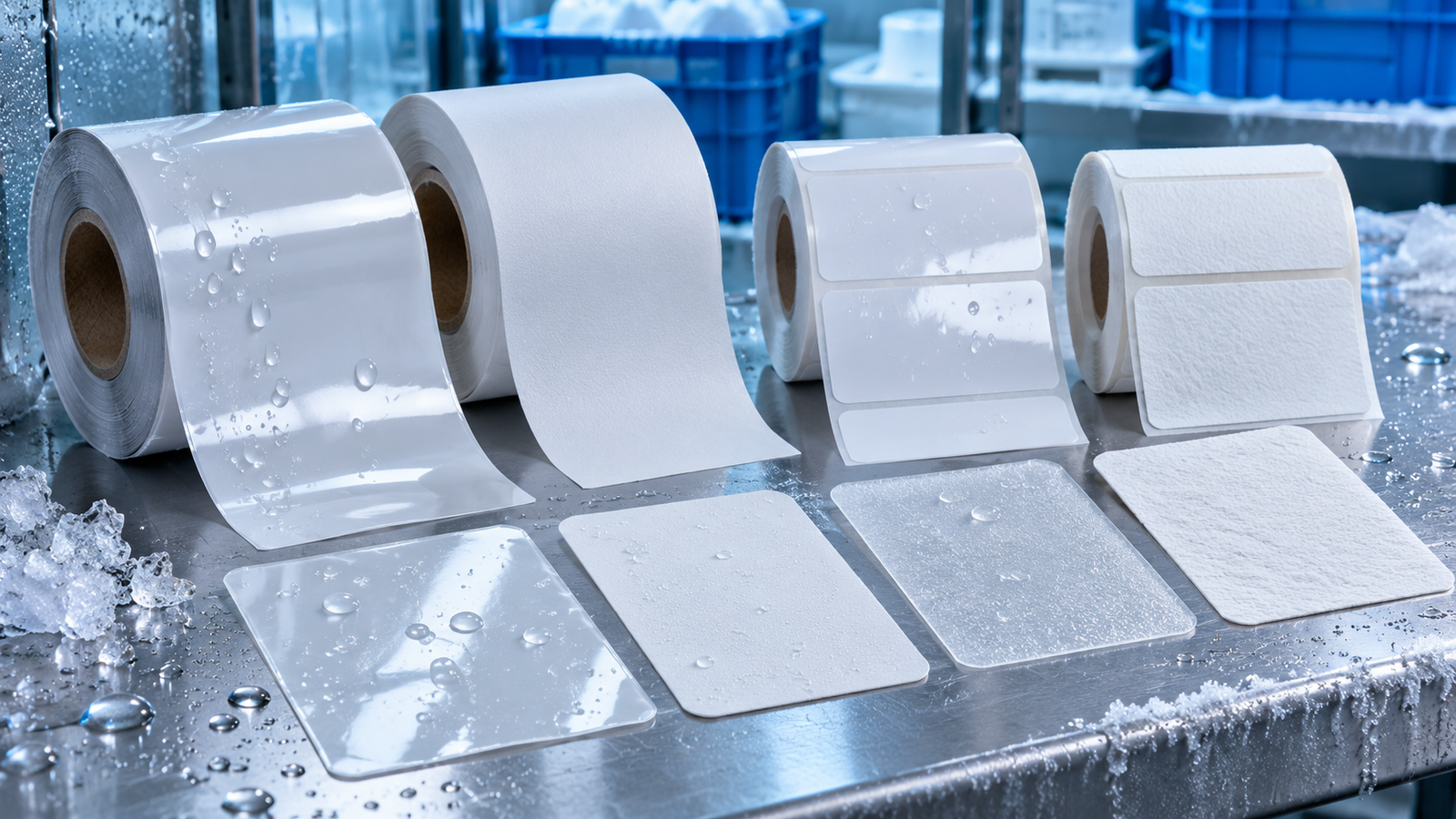
| Material Direction | Typical Consideration | Buyer Question |
|---|---|---|
| Paper label | May suit selected dry applications | Will condensation, moisture, or freeze-thaw cycling occur? |
| PP or PET film label | May be considered for moisture-prone or durable applications | Is the selected construction suitable for the actual package and temperature range? |
| PE film label | May be considered for flexible packaging | Does the label need to conform as the package flexes? |
| Clear or white film | Changes background visibility and contrast | Will graphics remain readable against the package? |
| Lamination or finish | May add specified surface protection | Does it support the handling and readability requirements? |
Adhesive planning
Choose Adhesives for Frozen Food Labels
Adhesive selection should follow the actual temperature and surface, not only the phrase “freezer label.” Consider labels applied at room temperature before freezing, in chilled conditions, or to pre-chilled packaging as different cases. Frost, condensation, oil, residue, surface texture, and the time available for bonding can change the result.
Adhesive planning checklist
- What is the package surface material and surface finish?
- What temperature is the packaging when labels are applied?
- Is the package dry, wet, chilled, frosted, or frozen?
- What is the lowest expected storage temperature and handling cycle?
- Could oils, fats, sauces, or residues contact the label?
- Is application manual or machine-applied, and can the construction be evaluated on the actual package?
Cold-chain exposure
Plan for Moisture and Frost
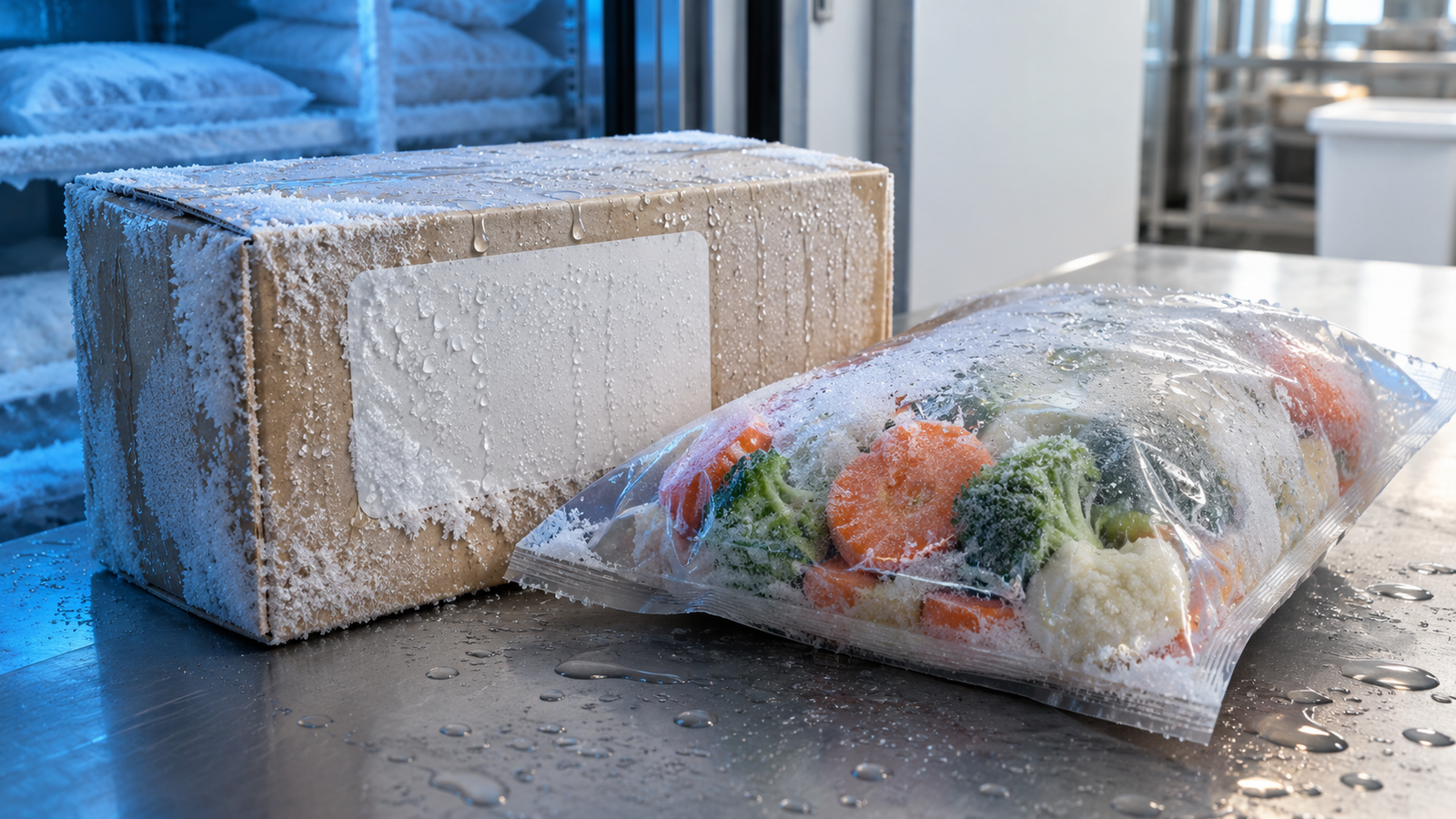
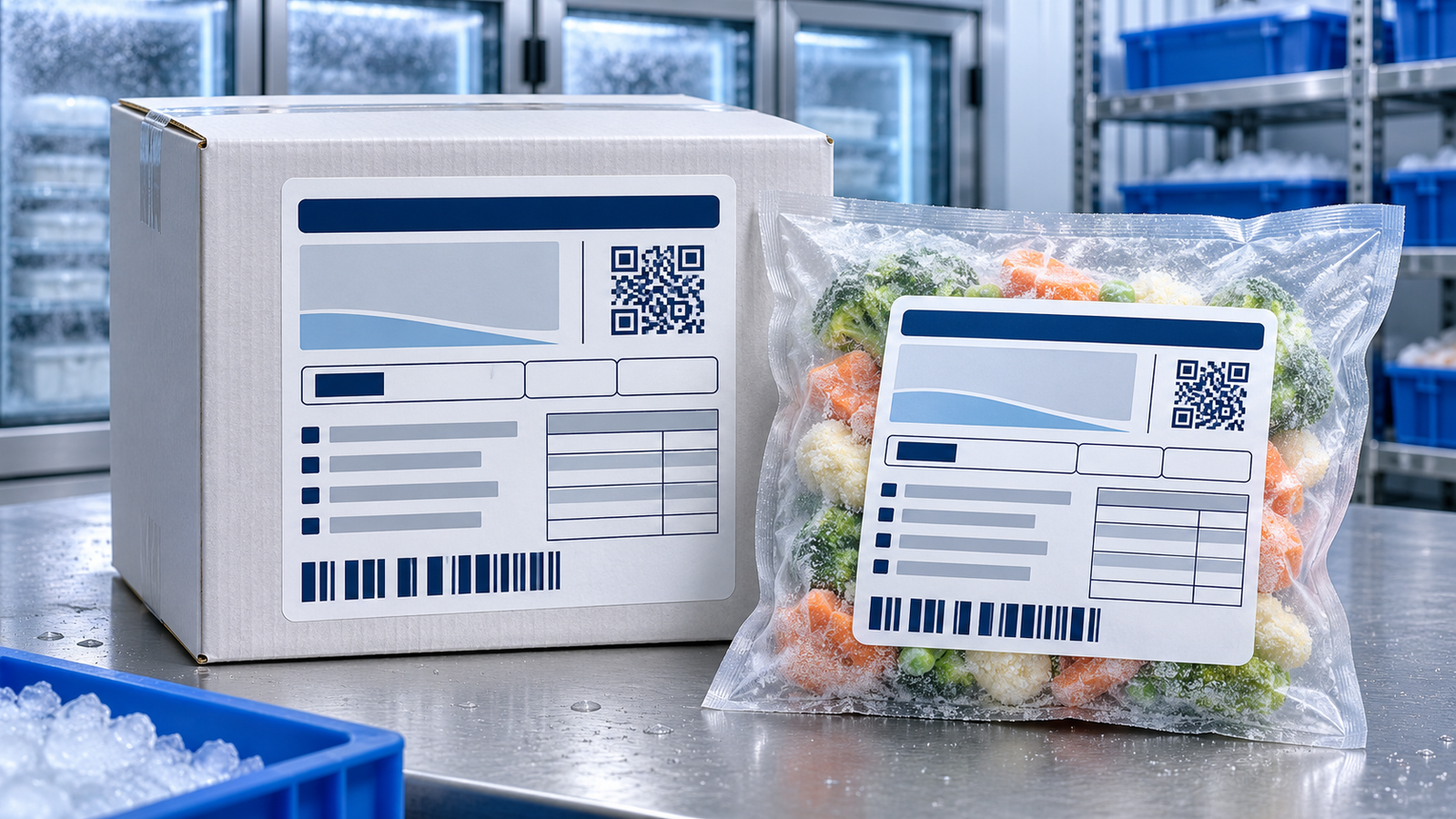
Frost and condensation can interfere with adhesive contact and label appearance. A label applied over frost may bond to the frost layer rather than the package surface. When the pack returns to a warmer area, moisture can collect at edges and around folds. Freeze-thaw exposure may introduce repeated stress that a desk-top proof will not reveal.
Cold-chain performance should be evaluated after realistic exposure, not only immediately after application. Define whether packages can be labeled clean and frost-free, how soon they enter cold storage, and how they are handled at dispatch and retail.
| Condition | Potential Issue | Planning Action |
|---|---|---|
| Frost on package | Adhesive may not contact the package properly | Define whether labeling can occur clean and frost-free |
| Condensation after freezing | Moisture can affect edges and readability | Review temperature transitions and exposure time |
| Wet package surface | Reduced initial adhesive contact | Confirm cleaning, drying, and application process |
| Freeze-thaw cycling | Repeated moisture and expansion stress | Test under realistic distribution conditions |
| Cold storage handling | Scuffing, abrasion, and edge damage | Review finish and packaging-contact conditions |
Information and traceability
Plan Information for Frozen Food Packaging
Required product information depends on the product category and destination market. This guide is not legal or regulatory advice. The buyer should confirm food labeling, food-contact, allergen, nutrition, ingredient, date-marking, language, barcode, and market-specific requirements with the appropriate parties.
- Product name, brand, description, and pack information.
- Ingredients, allergens, preparation, storage instructions, and warnings where required.
- Batch, lot, packing, freezing, or expiry details where required.
- Barcode, QR code, retail data, and responsible-business details where required.
Readability checklist
- Confirm final text size at actual print size.
- Check contrast against the selected label and package background.
- Keep critical information away from creases, seal zones, and high-wear areas.
- Reserve clear space for barcode or QR-code requirements.
- Control artwork versions for each product, market, and language.
Variable data
Barcodes, Dates, and Variable Data
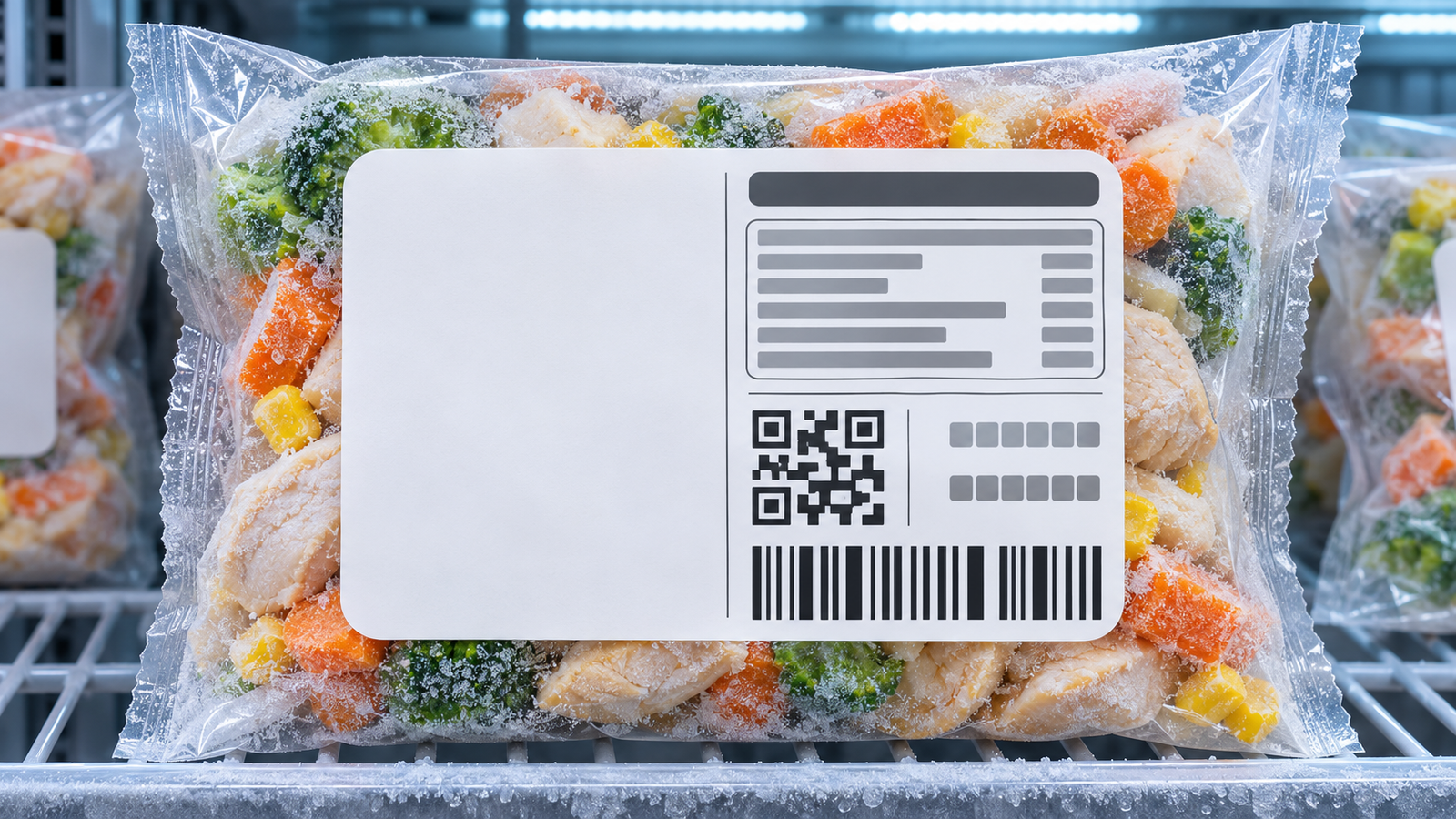
Frozen food labels may carry retail barcodes, lot codes, dates, production codes, or other variable data. These elements need their own planning: data source, code type, physical size, contrast, quiet zones, position, human-readable text, and the intended scan environment.
Printing a code does not automatically guarantee scanning or regulatory suitability. Agree any scan test, verification, acceptance rule, and responsibility for data accuracy before production.
| Variable Element | Typical Use | Buyer Requirement |
|---|---|---|
| Barcode | Retail, warehouse, and inventory scanning | Code type, data, size, contrast, quiet zones, and scan environment |
| QR code | Product information or approved digital content | Encoded content and physical code requirements |
| Batch or lot code | Traceability and production reference | Exact format, data source, and location |
| Date code | Production, freezing, best-before, or expiry reference | Required format and controlled data source |
| Product variation | Flavour, pack size, language, or market version | Approved artwork and version control |

Pre-production review
Test Frozen Food Labels Before Production
A physical evaluation can identify adhesion, material, readability, and handling issues that are not visible in an artwork proof. Test conditions, duration, acceptance criteria, and responsibility should be agreed for the individual project.
- Confirm the actual package substrate and surface condition.
- Define application temperature and expected service-temperature range.
- Apply the proposed label to a representative package.
- Review fit, corner contact, and edge adhesion.
- Place samples through realistic freezing, storage, handling, and temperature transitions.
- Check for lifting, wrinkling, print damage, moisture effects, and readable information.
- Review barcode or QR-code function if required.
- Record approved construction, package, artwork, and acceptance criteria.
Risk reduction
Avoid Common Frozen Food Label Problems
Common issues are usually brief-definition issues before they become material issues. Identifying the application moment, surface condition, package geometry, and route through the cold chain gives a supplier a practical starting point. It also helps procurement compare proposals on the same basis.
| Common Problem | Better Planning Approach |
|---|---|
| Label lifts after entering the freezer | Confirm application temperature, package surface, adhesive direction, and bond time. |
| Label is applied over frost | Label clean, frost-free packaging where possible or define a verified cold-application requirement. |
| Label wrinkles after thawing | Review material, moisture exposure, cycling, and placement. |
| Text is difficult to read | Review font size, contrast, glare, and package background. |
| Barcode does not scan | Confirm code size, contrast, placement, print quality, and scan environment. |
| Weak adhesion on film | Confirm film type, surface energy, contamination, and adhesive selection. |
Operations planning
Connect the Label Brief to the Packaging Line
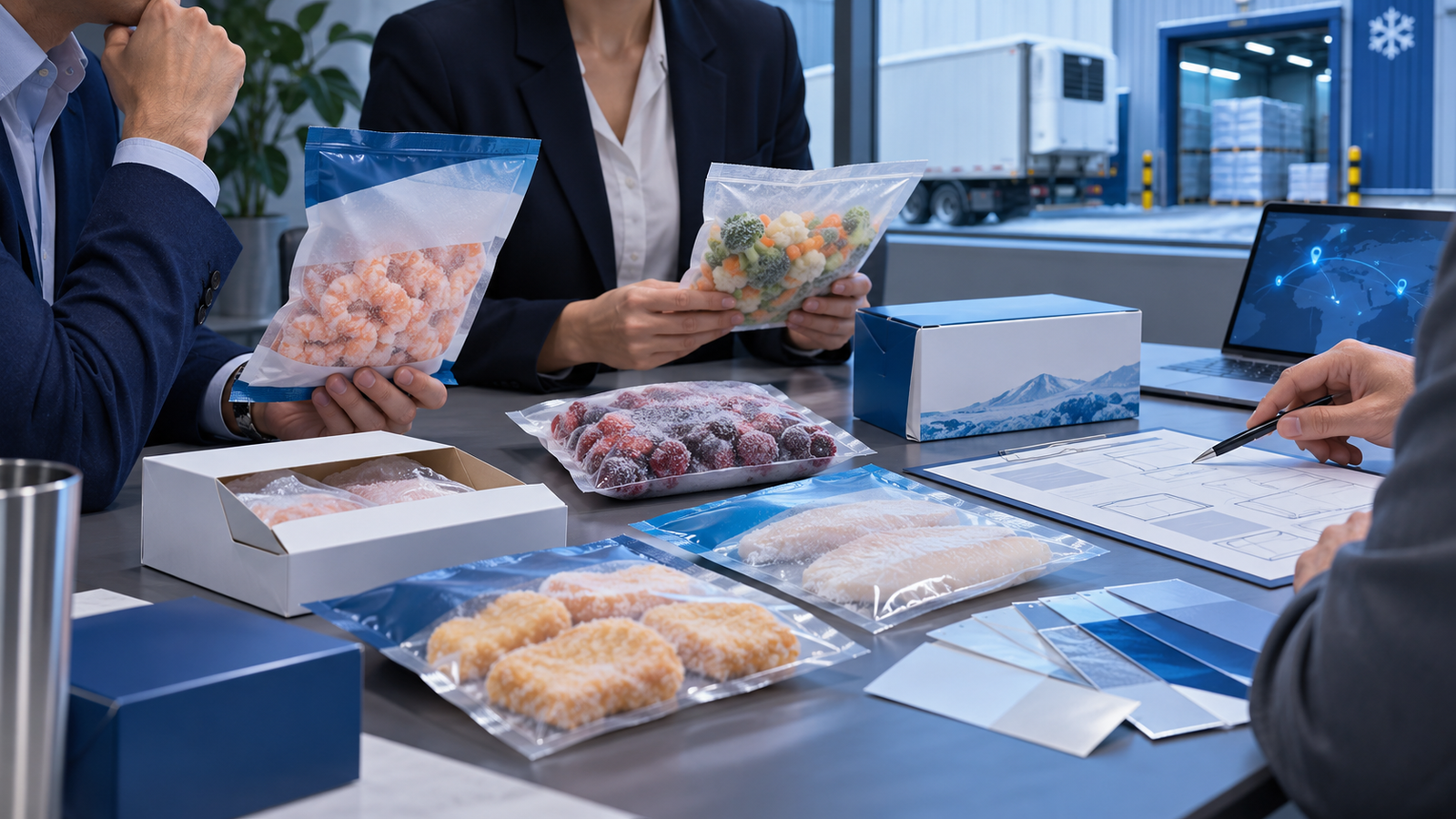
A workable frozen-food label is not defined by material alone. Packaging operations affect label fit before the product reaches storage. A manual operator may place a label in a different position from an automated applicator. A line may present the pack flat, upright, moving, wet, or immediately before a freezing stage. These practical details determine which contact area is available and how consistently labels can be applied.
Map the package route from filling to warehouse. Note when product is sealed, when it is cooled or frozen, whether outer cartons are labeled separately, and when variable information is introduced. A label for a retail pouch can have a different task from an outer-carton label used in warehouse handling. The information hierarchy, placement, and label construction should follow that task.
For co-packers and multi-site brands, document the process rather than relying on informal knowledge. One plant may label a dry pack before freezing while another receives pre-chilled goods. An artwork and label specification that does not state the application conditions can create inconsistent results across sites.
| Operational Step | What to Define | Why It Helps |
|---|---|---|
| Pack presentation | Flat, curved, flexible, rigid, moving, or stationary | Defines usable label placement and application method. |
| Application point | Before cooling, in a chilled area, or after freezing | Separates application temperature from later storage conditions. |
| Surface condition | Dry, clean, cold, wet, frosted, oily, or textured | Helps avoid assumptions about initial adhesive contact. |
| Information timing | Pre-printed, printed in-line, or added later | Clarifies artwork, data, and inspection responsibilities. |
| Outer-pack process | Carton, pallet, and warehouse identification needs | Separates consumer packaging from logistics identification. |
Buyer handover
Prepare a Clear Frozen Food Label Request
Purchasing can accelerate a technical review by sending one controlled brief. The goal is not to predict a material or adhesive before the project is reviewed. The goal is to give the manufacturer enough context to identify questions, compare options, and prepare a quotation around the real product.
Start with a sample or clear photographs of the actual package. State where the label sits, whether it crosses a curve or seam, and whether it must remain readable through freezer storage, transport, retail display, or consumer handling. If a code, date, or batch field is used, identify who owns the data and which version is approved.
Quantity also needs context. A one-time launch, a recurring SKU, a promotional version, and a multi-language program can have different artwork-control and packing needs. State the target quantity, repeat cadence if known, packing preference, destination, and required delivery timing. These facts allow the discussion to remain grounded without making unsupported claims about production capacity or lead time.
Frozen food label RFQ checklist
- Package sample or photographs, substrate description, and label location.
- Label dimensions, shape, artwork files, colours, and required finishes.
- Application temperature, service conditions, storage conditions, and cold-chain route.
- Surface state at application: dry, chilled, wet, frosted, or frozen.
- Required food information, languages, codes, dates, and buyer-owned compliance requirements.
- Quantity, repeat demand, packing format, delivery destination, and requested timing.
- Sample, testing, inspection, scan, or acceptance criteria where required.
Artwork and placement
Plan Label Size, Placement, and Information Hierarchy
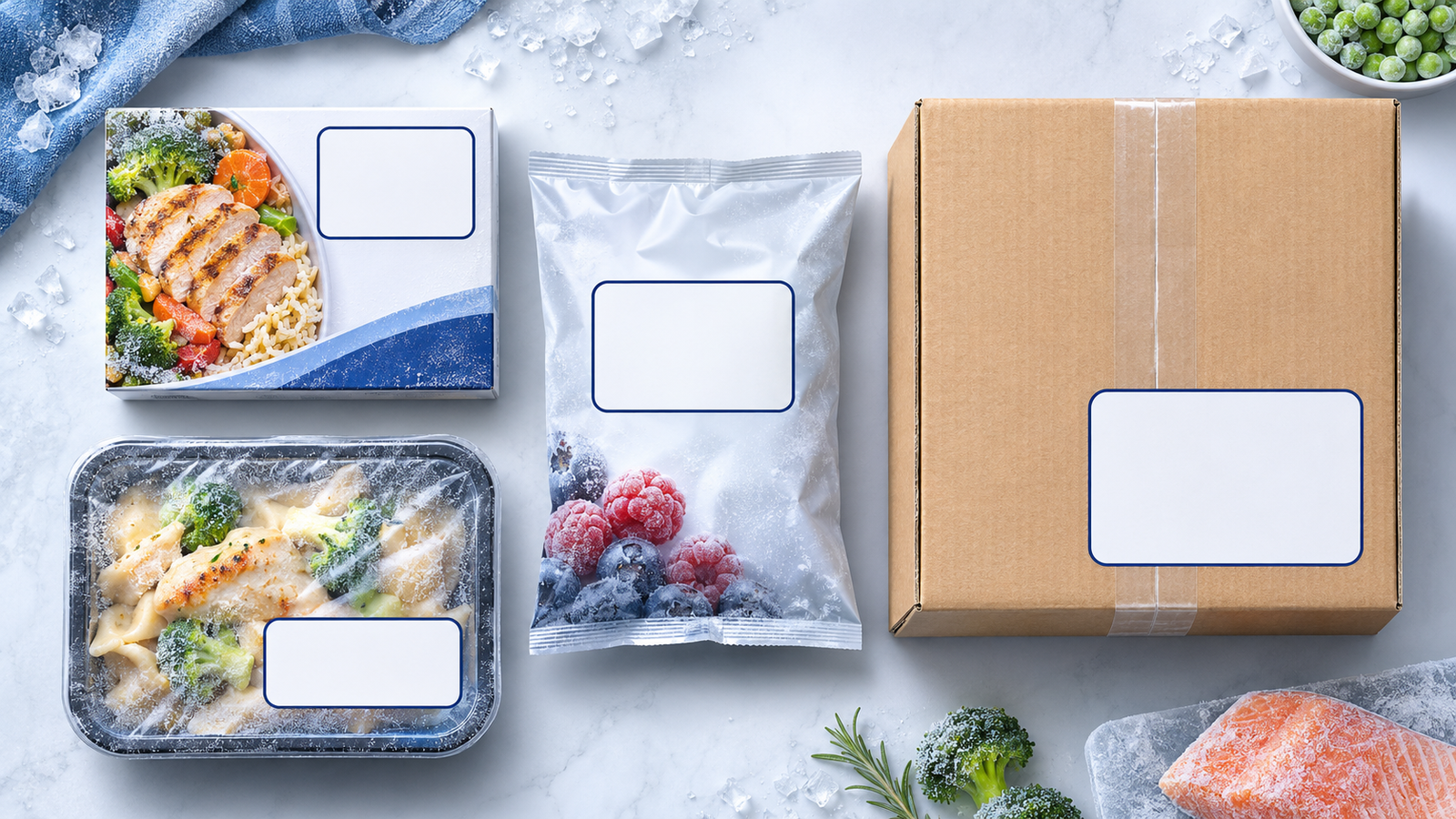
Label dimensions should be confirmed on the real frozen-food package, not only in flat artwork. A pouch can change shape after filling; a carton can have folds, seams, and panels; a tray may have a lidding film that is not suitable for every label position. Leave deliberate clearance around seal areas, corners, tamper features, and package edges where handling can create abrasion or lift.
Information hierarchy matters as much as physical fit. A shopper may need a clear product name and preparation direction; a warehouse team may need a scan area and human-readable identifier; a packer may need a date or lot field. These uses compete for limited space. Prioritise mandatory and operational information before decorative graphics, then review the final layout at full size on the intended package.
Where multiple markets or languages are involved, avoid treating the label as a single static image. Control the artwork version, language version, date-format rule, barcode data, and any market-specific information as connected records. A visually similar carton can require a different file because the content, destination, or code data differs.
Placement review questions
- Does the proposed size fit the usable panel after filling and freezing?
- Will the label cross a curve, crease, seam, perforation, or opening feature?
- Is critical information exposed to repeated rubbing, condensation, or handling?
- Can operators and scanners access the code at the intended point in the process?
- Are all language, date, and artwork versions clearly identified before release?
| Layout Element | Planning Question | Practical Review |
|---|---|---|
| Product name and brand | What must be visible first at retail? | Check contrast and placement on the actual pack face. |
| Ingredients and instructions | How much text is required at final print size? | Read a physical proof under normal viewing conditions. |
| Barcode or QR code | Where can a scanner reach it without folds or glare? | Reserve adequate clear space and test in the intended environment. |
| Date and batch fields | Who controls the data and when is it added? | Confirm the format, field size, and artwork version. |
| Label edge | What happens at corners, seams, and package curves? | Review after filling, freezing, transport, and handling exposure. |
Project review
Make the Supplier Review Specific
A supplier review is most useful when it compares a defined proposal to a defined use case. Avoid broad requests such as “need freezer labels” without package details. Instead, describe the substrate, fill condition, label position, application temperature, target cold-chain conditions, quantity, and required content. This gives both sides a way to identify what is known, what needs testing, and what must be approved by the buyer.
Separate technical questions from commercial questions. Technical questions include package surface, material direction, adhesive direction, print contrast, finish, code placement, and test conditions. Commercial questions include order quantity, repeat demand, packing, destination, sampling needs, and requested timing. Both sets are important, but one should not replace the other.
Record decisions in an approved brief. The brief can identify the package version, label dimensions, artwork revision, data source, application route, and any agreed sample or acceptance conditions. If any item changes—such as a new pouch film, a revised carton coating, different freezer handling, or a new destination market—review whether the label requirements should also be rechecked.
Questions to close before release
- Which package version has been evaluated?
- What are the defined application, service, and unused-label storage conditions?
- Which artwork, data, language, and barcode versions are approved?
- What handling, cold-storage, and temperature-transition conditions matter?
- What sample, test, inspection, and acceptance criteria have been agreed?
- Who is responsible for buyer-owned regulatory and product-information confirmation?

FAQ
Frozen Food Label Questions
Do not assume so. Application temperature, frost, moisture, package surface, adhesive direction, and process conditions must be reviewed separately from service temperature.
Condensation exposure should be defined in the project brief. Material, adhesive, finish, application timing, and package handling should be evaluated on the actual package under realistic conditions.
They can when the buyer confirms code type, data, size, contrast, placement, date format, source data, and any required review approach.
Share package samples or photos, label dimensions, artwork, quantity, package surface, application temperature, storage conditions, required information, and delivery destination.
Summary
Build frozen food labels around the real cold chain.
Labels for frozen food packaging should be planned from the actual application temperature, service temperature, package material, moisture exposure, handling, information layout, and distribution cycle. A “freezer label” description alone is not a complete specification.
Start with the package and process. Confirm artwork, material direction, adhesive direction, readable information, variable data, test conditions, and acceptance criteria before a larger order. StikTec can discuss buyer-defined requirements for custom pressure-sensitive labels, roll labels, waterproof labels, and barcode labels.
Discuss a frozen food label projectProject inquiry
Plan your frozen food labels.
Share package details, artwork, label dimensions, quantity, application temperature, storage conditions, product information, and delivery requirements. StikTec can review the project around your buyer-defined brief.
Related articles